



Although well received by the market, a Brazilian court’s decision ordering the Federal Government to transfer additional funds to the country’s patent office (INPI) did not receive the expected response from the agency itself. “The INPI does not have the capacity to execute (spend) more than US$ 24 million per year,” said its president, Julio Cesar Moreira, referring to the institution’s current budget.
In other words, even with more resources available, the INPI would not be able to use them immediately. To do so, it would first need to resolve legal issues (public servant hiring laws) and infrastructure problems (IT systems).
These issues have long affected key performance indicators at INPI including, crucially, the patent examination backlog. According to a study by the Licks Attorneys, more than 72,000 patent applications are currently awaiting a decision (see Figure one).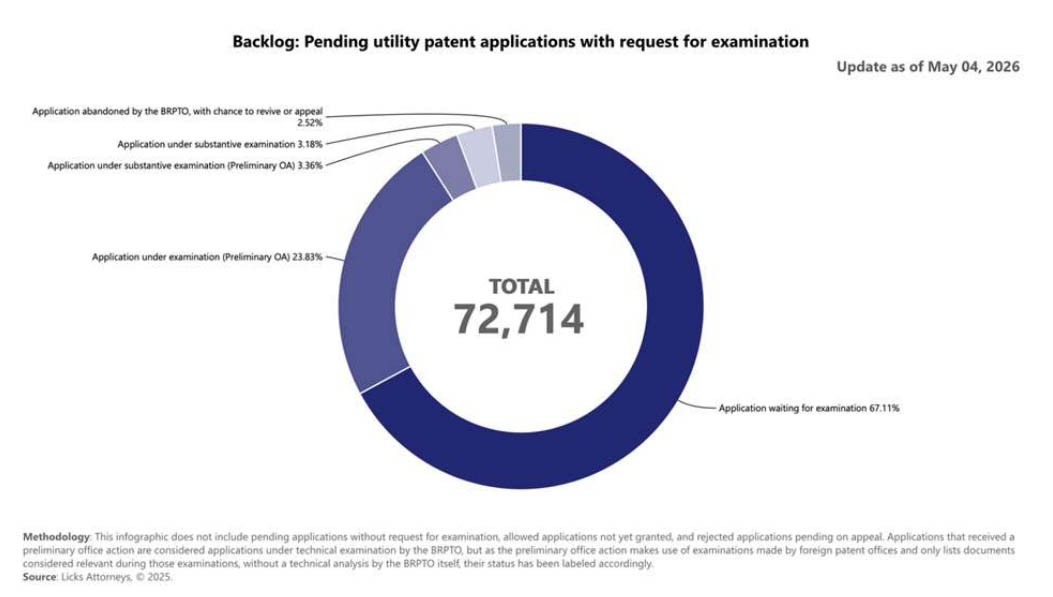
Source: Licks Attorneys
In the United States, the world’s largest consumer market, the patent examination backlog reaches 776,000 applications against an annual demand of approximately 788,000 filings. In Brazil, the annual filing volume stands at 29,000. Proportionally, for every new application the USPTO receives, nearly one remains pending. At the INPI, each new filing competes with 2.4 others already waiting.
The apparent impasse faced by Latin America’s leading patent examination office has drawn the attention of IP players.
“We understand that the lack of resources has impacted different aspects of the INPI’s delivery in recent years, including delays in decision-making,” says Felipe Alves, legal, compliance, and intellectual property director at the Association of the Research-Based Pharmaceutical Industry (Interfarma).
Partial 2026 results show that after 10 consecutive years of declining average time to issue the first decision, the indicator has risen again, reaching six years (see Figure two). In the United States, Europe and the UK, the average wait times are one year and 10 months, 18 months, and one year, respectively.
Figure two: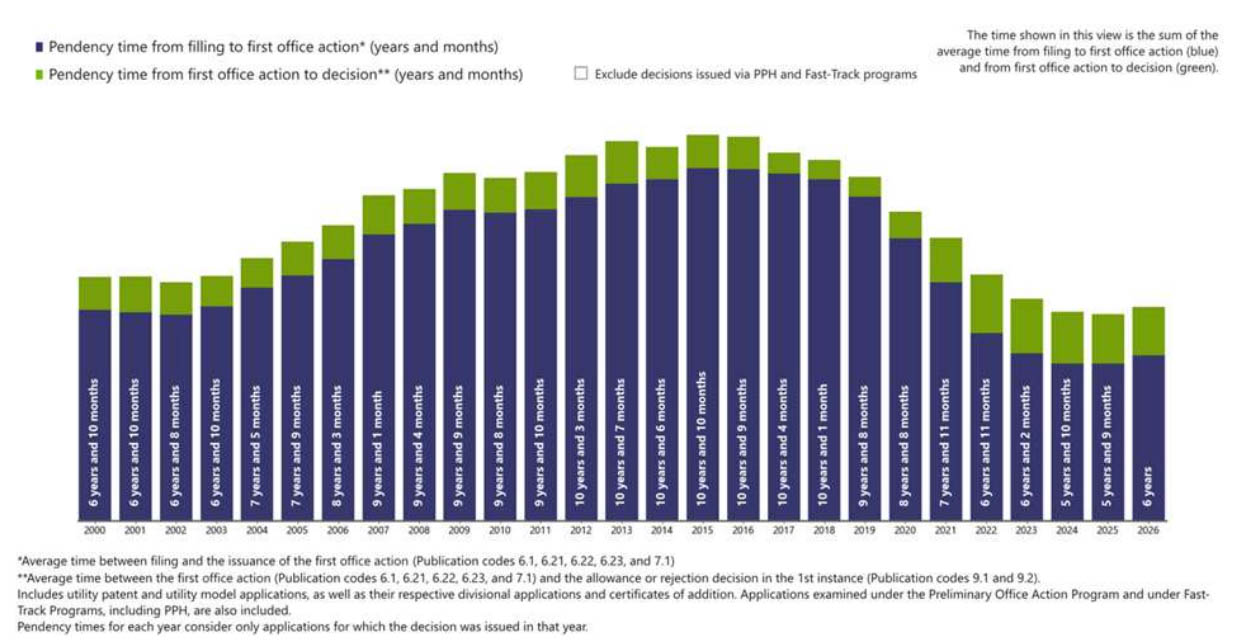
Source: Licks Attorneys
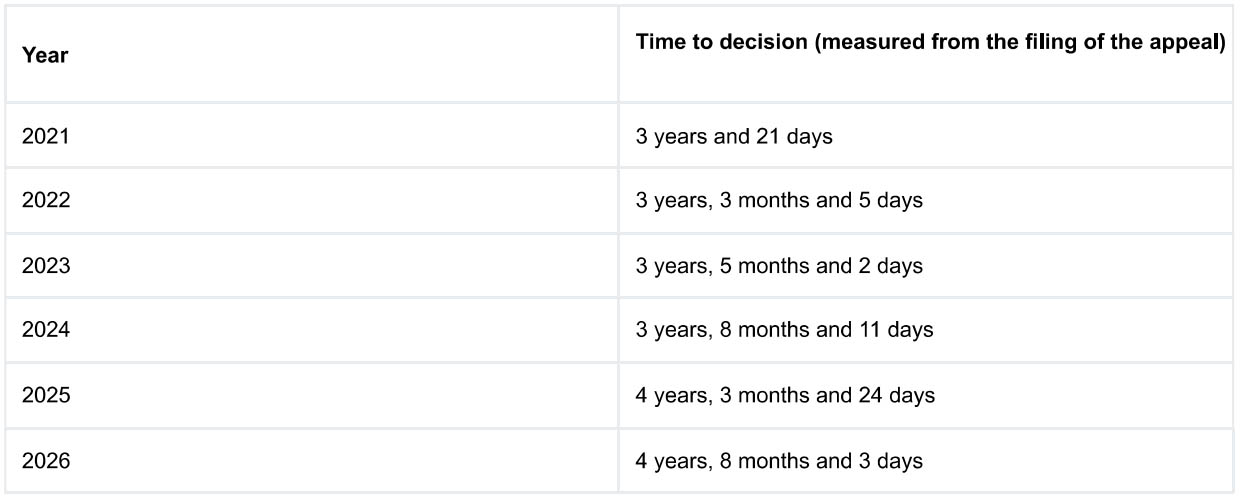
A similar trend is also seen in second-instance decisions (see table below).
Table one:
 Source: Licks Attorneys
“We have observed progress by the INPI in trying to reduce this timeframe, but the results are still far from the averages of developed countries and, in some cases, perhaps even from developing countries,” compares the Interfarma representative.
Commenting on the INPI president’s statement, attorney Luiz Edgard Montaury Pimenta observes: “In the short term, that would indeed happen [inability to invest the resources], but no one wants to break the natural order of things. Without money, nothing gets done.”
He notes that INPI finds itself in a peculiar financial situation: it is one of the few executive-branch agencies in Brazil that generates more revenue than it spends. However, due to the government’s fiscal choices, the agency has historically had no access to this surplus.
“That money exists [around US$ 706 million], but it is blocked. Why not use it to improve the INPI?” asks Pimenta, a partner at Montaury Pimenta, Machado & Vieira de Mello. “Once that money becomes available, they will have to create this investment plan. That is exactly what was reiterated in the second-instance ruling [by the Federal Regional Court of the 2nd Region (TRF-2)].” The attorney led this public-interest civil action against the Brazilian Government on behalf of the Brazilian Association of Intellectual Property (ABPI).
According to the INPI president, any eventual investment plan should prioritise two operational aspects: INPI’s lack of autonomy to hire additional staff and its outdated IT system.
Moreira describes the current IT infrastructure as “below what is required”. “We have 16 different software systems that do not communicate with each other,” he
explains, “but we are working to automate the entire flow of trademark and patent processes.”
“A good IT system costs money,” notes attorney and founder of Licks Attorneys, Otto Licks. According to him, the INPI’s technological challenge should also include “the use of artificial intelligence and specialised computational tools in complex areas where patent applications contain large amounts of data for examiners to analyse.”
“The need for highly specialised examiners in specific technologies suggests that the INPI should join patent worksharing arrangements with foreign IP offices. Mexico and the United States already have a successful agreement. The INPI should join it. While the INPI has 20 technological divisions, the USPTO has 550.”
Licks also suggests that “the INPI should adhere to the European Patent Office’s (EPO) Validation System (or validation agreements), a framework through which the EPO extends the legal effect of European patents to non-member states”.
In early May of this year, a survey by Licks Attorneys found that the INPI had only 39 examiners for the pharmaceutical sector (chemistry and biotechnology) and 64 examiners for electronics and telecommunications. In the latter fields, the average wait time for a first decision is seven years and 10 months, and for the former, eight years and 11 months. The estimated backlog is 18,535 applications (electronics and telecommunications) and 11,645 (pharmaceutical).
“Given the size of its market and the ethnic diversity of its population, Brazil is viewed as an interesting market by the pharmaceutical sector. Obviously, greater legal certainty and predictability could further boost our investments,” says the Interfarma representative.
Among Brazilian IP law experts, the TRF-2 decision is very likely to be appealed to the Superior Court of Justice. However, it is worth noting that a second-instance ruling by the Brazilian judiciary can, depending on the panel’s understanding, be immediately enforceable. Thus, in some cases, even if an appeal is accepted (which happens only in a minority of cases) enforcement may continue while the case is being reviewed.
The parties involved in the case are awaiting the publication of the judgment to confirm what its immediate effects will be.
Source: